
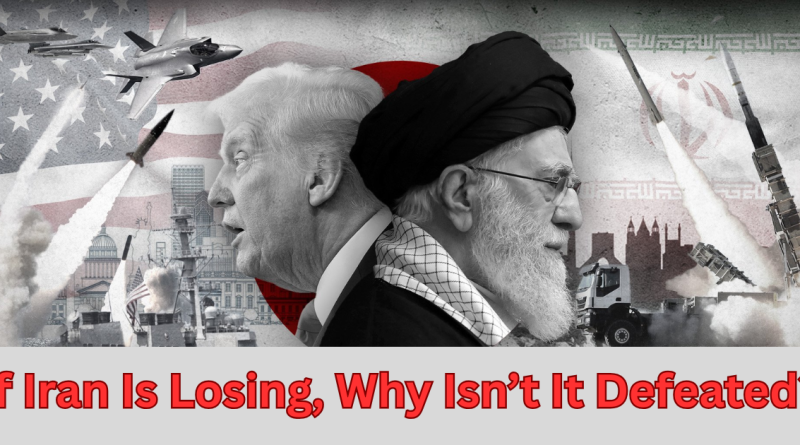
If Iran Is Losing, Why Isn’t It Defeated?
War does not only begin on the battlefield; it also begins in the narrative. In the scenario of the recent aggression of the US and Israel against Iran, President Donald Trump repeatedly declared victory over Iran. Both the United States and Israel tried to reinforce the narrative that military dominance ensures strategic success and paint a picture of total control as they eliminated key leadership figures, including the Supreme Leader and also caused massive infrastructure damage. However, beneath these claims lies a more complex reality.
The conflict’s persistence and escalation raise a few questions: can victories be claimed so easily? And if the war is already won, why is it still being fought?
This contradiction highlights the flaw in the narrative. Basically, destroying targets is not the same as winning the war. Iran is still standing, still responding and still shaping the battlefield. Iran’s continuous responses challenge the claims of the US President.
The Perception of Iranian Defeat
Both Washington and Tel Aviv claimed several times that Iran has been strategically weakened. Donald Trump repeatedly framed the U.S. actions as decisive, often stating that Iran’s capabilities have been “severely crippled.” No doubt, this narrative is not without some merits. Besides eliminating high-ranking political and military figures, the US and Israel also initiated hundreds of strikes to target Iran’s military infrastructure and strategic facilities.
It is pertinent to mention that their attacks were not only meant for military targets, but several pieces of evidence also highlight the killings of innocent people, including children and damage to civilian infrastructure.
The Case Against “Iran Is Defeated”
Even after heavy losses, Iran’s retaliation reflects another story. Iran’s continued ability to respond, adapt and impose costs highlights that weakening of a state is not the same as defeating it.
Continued Military Retaliation
Logically, a defeated state does not continue to fight with intensity. Yet Iran has precisely done that. Since the aggression began, it has been retaliating with its might, launching missiles and drones across the region and targeting U.S bases in the region and military infrastructure in Israel.
Since February 28, Iran has launched at least 5,471 missile and drone attacks targeting U.S. bases and other key strategic sites in seven Arab countries. No one can dub Iran’s response as a symbolic gesture but it seems coordinated retaliation. Iran’s ability to continue offensive operations in this month-long conflict reflects that it retains both capacity and intent.
Disrupting U.S. Regional Power
Iran responded strategically. It started attacking U.S. bases in the region to divide the focus and resources of its enemies. In this planned move, it caused serious damage to U.S. bases. It is trying to not only add pressure on the US, make the situation worse but also increase the cost of involvement. Iran basically understood its position and the weaknesses of its enemies. So, it is not trying to win this war quickly but striving to make this aggression too costly to sustain.
The Strait of Hormuz as a Tool of Leverage
Iran’s strategic power goes beyond its missiles and drones to the geography it controls. Iran has also exerted pressure far beyond the battlefield by strategically controlling the Strait of Hormuz, which carries nearly 20% of the world’s oil supply. The move significantly influenced global markets. Oil prices have gone up, which is creating tensions across global markets.
President Donald Trump repeatedly warned Iran to reopen the Strait of Hormuz and even set ultimatums with specific deadlines and threatened further military actions against Iran’s key energy infrastructure. He also called on other global powers to join in restoring the status of Strait of Hormuz but they refused to participate.
Despite these warnings and appeals, Iran has maintained control of the strait and has refused to fully open it to unrestricted commercial traffic. Basically, Iran has asserted its strategic leverage over this vital waterway, which highlights Iran’s strong position and strategic dominance.
No Regime Change
One of the key motives behind the U.S. and Israel aggression on Iran was to trigger political change within Iran. They expected that sustained military pressure, targeted strikes and killing of top leadership would weaken the control of the government and open the door to internal collapse. That, however, has not happened.
The Iranian government remains in place and its leadership is still intact. There has been no surrender, no overthrow and even no sign of internal regime change. One can simply ask: can this aggression truly be considered a victory? Wars are not won by destruction alone but they are won when strategic goals are achieved and in this case, these goals remain unmet.
The War Still Continues
Perhaps the clearest evidence is that the war is still waging and it seems far from over. Unless the war is over, no one can claim a decisive victory. Instead of stopping, the conflict is expanding and even adapting with every strike and countermove. Wars are won when outcomes speak for themselves and so far, this war has refused to yield a clear winner.
Is It Becoming A War of Iteration?
What becomes clear is that neither side is achieving a decisive victory. The United States and Israel could not meet their initially stated objectives and also could not stop the explosion of this conflict. And Iran, though retaliating, but cannot militarily defeat the U.S.
This is no longer a war of quick outcomes but has become a war of attrition, where time, resilience and economic pressure matter as much as military might.
So, if Iran is losing the war, why isn’t it defeated?
Because destruction cannot be dubbed as defeat, power does not guarantee control and resistance can be enough to evade collapse.